-
Tongue Out Flash
And here’s the other piece of flash fiction that I owe you! If you don’t remember, it was in response to this guy:

I leaned against a fresh fence post, leaning back and forth, waiting for my turn. “Granda, how long have you lived out here?”
He paused midway through yanking out another clod of soil with his post-holer and stepped back, wiping down his face with the bandanna he always kept in his back left pocket. “I would guess it’s about 60 years now. Your gran and I bought this place soon after we got married. Didn’t have any barns or anything then, just wide and open as far as you could see. We weren’t in it for the farming, which you can’t right do in most of Montana anyway, and we had no desire for ranching, we just wanted the space to either side of us, enough room to stretch a little.” He tucked the bandanna away and yanked the ‘holer from the ground, neatly removing his clump of dirt.
“This was back when you started teaching, right?”
He nodded to himself before shoving the ‘holer into the ground for it’s final time. “When I thought I could still make a smidge of difference at it.” He tossed the ‘holer aside and beckoned me forward with the final fence post. I stepped forward and slammed it down into the hole and started nudging dirt in around it with my foot.
“Why’d you ever stop, anyway? Mom always says you were a great teacher, one of the best.” I stamped and stamped around the post, trying to pack the dirt in as tight as I could.
“That’s good, that’s good, let it rest. I’m not going to string the wire tonight anyway.” He turned and slung the ‘holer over his shoulder and started back down the hill towards the barn that stood beside his house.
“Granda, really. Why? No one ever talks about it and I hate not talking about things.” I nearly ran into the ‘holer over his shoulder, he stopped so fast. His shoulders drooped and he dropped the tool to the ground before turning to me.
“Because it didn’t make one whit of difference when I’d be teaching this baby boys and they’d just go off and get themselves killed in war, or these young girls who’d just go and get pregnant. They were only at college to catch a man anyway. Once they’d accomplished that…pft, off they’d go. I got tired of trying to pound an ounce of knowledge into skulls too thick to make any use of it. That and after Marta died I may have slept with the Dean’s wife…and the Bursar’s wife. They weren’t too kindly towards me after that, let me tell you.”
“I…well. Not what I was expecting to hear, not by a long shot.”
“And just what were you expecting? Murder and intrigue on the high seas? The romance of the life of a rancher overwhelmed my distaste for these rotten creatures? Hell, boy, you watch too many movies. Life happened, end of story. Things change, your fate rises and falls, and sometimes you can’t do a damn things about it.”
I gave a half laugh. “Sounds like you were making your fate rise and fall all on your own, over and over again, am I right?” I nudged him in the ribs and winked Three Stooges style and he stuck his tongue out at me before slinging the post-holer back over his shoulder and starting back down to the barn.
-
Food Flash
So I’m almost all caught up and refocused, so here’s one of the fiction pieces I owe you! In case you forgot, one of the pending writing prompts had to do with food…
_____________________________________________________________I’d never known that I was different until I started a biology class in college where the professor had a particular fascination with synesthetes. You see, in this incredibly small portion of society, the senses are somehow linked together. Some people associate scents with particular words or colors even. That seems to be the most common, the words/letters with colors thing. At least, that’s what most of the literature seems to be about. It yaks on and on about all the famously talented people in the history of the world who were helped along by this slightly unfair advantage. I mean, when a composer sees colors associated with his music, he has an extra leg up because he can actually see if what he’s creating is beautiful, am I right? Maybe, who knows. Maybe I just want to believe that.
You see, I haven’t found anyone else like me in the literature yet and I’m hoping that this actually has some useful application rather than being the horrid nuisance that it has been for most of my life. For me, my sense of taste is directly linked to tactile sensations. And not just unilaterally, either, which seems to be unique unto me. When I eat, I feel things over my entire body and when I touch things, I taste them. Their texture and temperature seems to be the biggest factor for what I taste.
You ask what this means for me; let me give you an example. I have to buy 1500 thread count sheets because anything less leaves me awake all night long because every time I turn over I taste sulphur as the fabric scratches across my skin. I can’t eat anything minty in public because it stimulates…well…rather pleasant regions of my body. In fact, mint chocolate chip ice cream can send me right to an orgasm after a few bites.
I’ve broken up with people because the texture of their hands made me wretch and I’ve fallen in love with others because the taste they leave in my mouth is just so sweet. I hardly ever go to restaurants because hidden spices and herbs in my food can leave me itchy or feel like I’m burning.
I sat down to talk to my professor about all of this one day and ask for his advice in dealing with my problems. I was just so tired of not being able to function like any normal human being, shying away from touching anything when I’m out and spending outrageous amounts of money on clothing and furnishings just so I could live a comfortable life.
After his initial flurry of questions, most of which were fairly standard to determine whether someone was a true synesthete (I am, fyi) he asked me how I fed myself. We’d already been over the topic of restaurants, but we hadn’t talked all that much about what I did like in food. I started to tell him about the experiments I used to do when I was younger, combining different spices from my mother’s cabinet just to see how they would make me feel.
And then he asked whether I had ever consciously constructed a meal to evoke particular feelings. I hadn’t really thought about it until then, but that’s what I did on a daily basis. I knew certain combinations of foods made me feel good and didn’t set off any unpleasant sensations and I normally stuck to a fairly safe but boring standard fare. Pasta was good because it was a fairly neutral feeling, sort of this subdued warm glow. I could always rely on it when I’d had a bad day.
Then he asked, what if you started deliberately designing meals to make you feel a certain way, three course meals, five course meals that took me on a tactile journey, almost like making love to myself with the food. I joked I’d always end with mint chocolate chip ice cream and he laughed a bit uncomfortably. But seriously, he said, what if?
So I went home and thought about it for a while, tried a few combinations of flavors out, went shopping, and then sent out invitations to several friends and my professor to join me in a gustatory evening of trial and error. I had planned it all out…appetizers, salads, main course, dessert, and if my tactile senses didn’t steer me wrong, then this was going to instill feelings of warmth and soothing pleasure in all of my guests.
They arrived one at a time and I plied them with a wine I had matched to the meal, just to ensure they were a bit lubricated before introducing them to my cuisine. I’d never cooked for anyone else before, so I wasn’t sure what kind of reaction I was going to get.
The appetizers left me with a fizzy sensation tingling up my fingers and no one had anything bad to say about my home-made tapanades and crackers, so I moved them on to the salad. It was Mediterranean inspired, but with a slightly different spice base since cilantro leaves me feeling like nails had just run down a chalkboard. For the main course I served fish done in honey and mint, but a more gentle orange-mint so as not to overstimulate myself. Instead, it just left me feeling primed and amorous. And I finished it all up with a fruit tart with fresh mango sorbet on the side that defuses my arousal and leaves me with a pleasant post-coital glow.
I leaned back, savoring the last of the wine in my glass and asked my friends what they thought, if they had any ideas or suggestions. Did they like it? To a one, they were quiet, but most of them were grinning happily, a few of the more reserved friends looked a little sheepish and confused. My professor raised his glass in a silent salute.
Eventually, they recovered themselves enough to make a bit of small talk as we were clearing the dishes and they slowly trickled out, leaving the professor and me to talk as I started the dishes. I floated the idea of transferring to a culinary institute but he just shook his head and instead offered the idea of molecular gastronomy, sticking with the hard sciences like physics and chemistry, mainly because he felt I’d already surpassed what most people learned at a culinary school. He wondered if I couldn’t take things to a whole new level and completely revolutionize the concepts of comfort food or a dinner date. Imagine, food that feels like a caress, a kiss, a mother’s soothing touch. What if I could replicate that for everyone, anytime?
-
I’m going to name the wind…
And her name is Mariah. No, wait, wrong story. I wanted to talk about Name of the Wind and it’s sequel The Wise Man’s Fear by Patrick Rothfuss. Bonus points though if you get the Mariah reference and if you put it in the comments, I’ll think of a really cool prize…
But back on topic. Rothfuss has started us on an epic tri-part story in his Kingkiller Chronicles, starting with Name of the Wind and continued with The Wise Man’s Fear. There is no third as of yet, and only the briefest hint of one (there’s a title on Wikipedia) but no projected publication date or anything. When I got to the end of the second one and reached for the third, I yelled at my father for recommending an incomplete trilogy to me. (Rothfuss, you damn well better write the third before you pop off!)
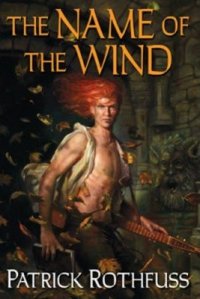
If my aside gives you any indication, these books are addictive. Like crack. And just about as bad for you, too. The story is following Kvothe, a young man who goes off to learn at the University and study what appears to be a mix of magic and science. Not a bad premise, and in fact the plot line and characters I have no problems with, which is unique for something as high fantasy as this. They are solid, well written, and engaging. And it’s that story that makes me want to keep reading because he drops tantalizing hints all the way through of things to come that–if he pulls it off–will make the third book the most goddamn exciting thing I’ve read for a while.
No, it is not the story of the characters with which I find fault. It is the method of delivery. This trilogy is couched in a storytellers format with the current timeline taking place in Kvothe’s tavern where he is hiding out and telling his life story to a traveling historian called Chronicler. So there’s that going on. And then we have the story that Kvothe is actually telling.
Now, sometimes this is done extraordinarily well, where either the back story or the current story are kept mercifully brief and unobtrusive. A prologue and an epilogue, say, of the storyteller. Or a chapter here and there of flashback. But the story takes place in one timeline or another. With Kingkiller Chronicles, it feels almost like Rothfuss is trying desperately to drag us up to the current timeline cause there’s just so many exciting things happening today, but there is so much that leads up to and informs current events that we need over a thousand pages dedicated to it. And to top it off, the current timeline keeps interrupting the main block of storytelling, sometimes literally in mid-sentence.
That’s when I yelled at the book. Once I figured what in hell was going on with the end of the chapter and it wasn’t just an e-book error. Poor choice, Rothfuss. And the current events just keep interrupting! We get it, shit’s bad, go away and let me GET to you already. Here we are, 1500 pages in, and we still don’t know how you hooked up with the demon man or even what your relationship actually is with him; we don’t know what the damn spider things are that are wreaking havoc; we don’t know why you’re called a Kingkiller cause all you’ve done up until now is save a King here and there. You talk about long arduous days at the university but then entirely SKIP OVER stories about mayhem and storms on the high sea. I’m much, much more interested in hearing about being captured by pirates then I am about you griping about not having money. Or did your editor insist you take parts out because it was too long to print, so you just decided to summarize in one paragraph what should have been a kickass couple of chapters? Here’s an idea, go back through and make your character quit his whining. We got it already, he spends most of his time broke and missing the crazy chick. Check.

But for all of this, you want your next fix. I crave the third book even though I know Rothfuss is going to have me yelling and throwing a tantrum over being interrupted YET AGAIN by something happening in the current timeline because I just don’t care. Kvothe’s storytelling is much more interesting. This concludes my withdrawal rantings about the Kingkiller Chronicles. If you want to read them, the story is fantastic, but I might wait until the third book is out, if I were you. The story shakes aren’t all that pleasant.
-
Dead Seagulls
I have read so many books that refer to or quote from Anton Chechov, that I knew eventually I would have to pick up one of his works, regardless of my tempestuous relationship with Russian literature. And lo, a wild play appears! No, really, it was free on the Kindle. Chekhov’s The Seagull.
For this review, I have to try very hard to separate the technical critique from my personal reaction, so we’ll go with the part that should be impartial first. I can admit, right up front, that I think Chekhov deserves the reputation that he has. My trouble with Russian literature is that I’m not reading it in Russian, nor am I Russian, so I’m sure I’m losing a lot of the tone and references and everything that makes some of these unbearably melodramatic works wonderful. But with Chekhov, I can relax into his writing and not constantly be ripped out of the narrative because my suspension-of-disbelief shattered over a character’s actions. So that definitely helped. He also presented the ideas in this work in a unique way that pushes the comfort boundary of his audience (at least this audience) in its use of a dead seagull as metaphor. So, in all of that, I found it remarkably successful.
Of course, therein also lies my complaint about this play. A fledgling writer who has yet to make their first big step onto the publishing stage should NOT read this when in a vulnerable state, such as looking for an agent. *cough*ME!*cough* It presents an incredibly bleak perspective of young writers and the art/popularity bipolarity. And it does not end happily for the young writer involved. Yes, the well established writer is doing fine, but young Konstantin Gavrilovich Treplyov does not do so well. (Yeah, say that 10 times fast.) I don’t want to spoil things too much for those who like a decent surprise in their plays, but he ends up rather like that seagull he shot in Act II. The whole thing feels like an enormous metaphor for the emerging writer, with Nina Mikhailovna Zarechnaya playing the part of the fickle public who is loyal and adoring to an older, established writer, while still liking the attentions of the young artist. So, on the whole, not real encouraging to all of us fledglings out here trying to get our wings under us.
In summary, maybe don’t read this one as your first Chekhov when trying to break into a notoriously capricious market, but it is still a fine example of Russian play-writing.

-
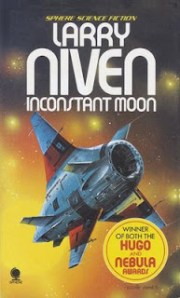
Inconstant Moon
A friend of mine was asking about speculative fiction and it’s literary value, so I spent an evening trying to remember the titles of all the sci-fi, fantasy, dystopian, etc that I considered of a literary caliber. It took a while to remember the title of one particular story, but Google came to my rescue and informed me it was “Inconstant Moon” by Larry Niven. And then I learned it was part of a collection of speculative stories that Niven had published in the ’70s and I determined there and then that I would get my hands on a copy.
The collection Inconstant Moon is a fun little collection of tales of adventure and chaos. They are pretty much uniformly dystopian in various distinct and different futures. There is an apocalyptic even with the moon (which would be the title story) and a dark futuristic noir about addiction to stimulation of the pleasure center of the brain.
While I found the stories entertaining, they also don’t seem to stick in my mind much, except for “Inconstant Moon.” I remember enjoying them immensely while reading them, and they were fantastic in their construction, but now, about a month later, I’d be hard pressed to tell you what the individual ones were about. I’m sure I could go back and figure it out, but, frankly, I’m not all that motivated to. “Moon” was just as good as I remembered, but it seems to be the stand alone strong piece in the collection.
But, if you’re a fan of Gaiman flavored dystopian science fiction worlds, you’d probably find this short read just as entertaining as I did!
-
Vonnegut and Slapstick
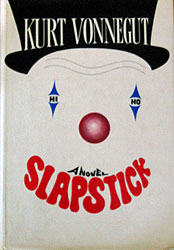
They recently started doing this new flee market in a parking lot near my house and I just couldn’t resist this last weekend. On my stroll through over-priced hipster collectibles booths, I stumbled across a box of cheap paperbacks and promptly bought 2 (after making sure I didn’t want anything else at the market, that is); Slapstick by Kurt Vonnegut and Island by Aldus Huxley. I promptly sat down and read straight through Slapstick and Island is next on the list, but I wanted to share this little odd ball with you first.
It was kind of reassuring after reading Basic Training to come back to something approaching what I consider Vonnegut’s classic style of absurd science-fiction. Yes, I know you’ll say all science-fiction is absurd and unrealistic, but Vonnegut’s storytelling style is what pushes his sci-fi from standard to absurd. You can have all the hyper-realistic, nitty-gritty star adventures you want, but there is something about the simple, stripped down and straightforward delivery of Vonnegut’s crazy scenarios that makes his work simultaneously chilling, enlightening, and hilarious.
In Slapstick, The King of Candlesticks is writing his memoirs on the eve of his 100th birthday in which he recounts being born a di-zygotic neanderthaloid with a sister who, when they put their brains together, were some of the smartest people on the planet. After her death, he continues on to become the last President of the United States and through a series of unfortunate events, the United States collapses and he ends up living on the Dead Island of Manhattan along with his pregnant granddaughter. Like I said, more than a touch absurd.
The story line itself is less interesting than some of the concepts and strategies Vonnegut employed for this novel. One of which is that everyone is lonesome and in order to correct for this, as President, he institutes a policy wherein he gives everyone an artificial new middle name to group people into enormous extended families. He himself is a Daffodil-11. It really made you stop and think when all these people–as their country slides into disrepair and illness–happily turn to supporting and welcoming total strangers who they have been told by a randomizing computer that they are now to care for each other.
He talk a lot about not only this truly artificial regrouping of people but also the natural extended families that we create for ourselves on a daily basis: fraternities and career networks; bar-hopping friends and book-shopping friends; families we marry into or divorce out of. It really is amazing when you sit down and start thinking about just how many people we reach out to and connect with on a daily basis and how we tend to group them around ourselves for particular kinds of support. The President simply took it one step further and mixed everyone up so that there was the greatest representation of careers, ages, and ever other descriptor you could think of in these enormous families.
A couple of other, slightly less interesting, concepts were the fact that gravity had become a variable, and so you never really knew how heavy everything would be from day to day and from there he once intimates that the Chinese, who have shot far ahead in their science, have figured out how to arbitrarily control gravity. I’m not quite sure where he was going with the two intertwined concepts, but they kept me amused through the novel.
Stylistically, it’s about on par with Slaughterhouse 5, in that it is chapters of small snippets with interjections of a catchphrase throughout. Here, the phrase is, “Hi ho.” It slips in almost as a punctuation mark in places. He calls it a senile hiccup, but after the first few irritating interruptions, it became a soothing “So mote it be” to the sections and seemed to make way for a small breath before starting forward. When he first started using it, I questioned whether I would be able to stand it, but by the end, I found myself smiling at each “hi ho.”
I don’t mean to sound like a total fan-girl, but I have yet to read a Vonnegut that I dislike. I find him thought provoking and I’m sad it took me 24 years to actually get around to reading him, but I’m trying to make up for lost ground now, one flee-market book at a time. So, if you’re looking for a good Vonnegut or even just an easy, somewhat humorous read, Slapstick is for you.
-
Extremely Ludicrous and Incredibly Obtuse
So, with all the bru-ha over Extremely Loud and Incredibly Close by Jonathan Safran Foer, I thought I’d give it a try. There are times I regret my decision to read best-sellers as market research and this is one of those times. On a normal day, I wouldn’t pick up a book proclaiming to be a funny and moving tale of emotional recovery by a child after losing his father to September 11th, but so many people had fallen in love with Foer, and I found a free copy, so I figured I’d read it…I made a mistake.
One of my professors, Maria Flook, once went on a rant about child narrators, including chastising the offending student on their voice and content before segueing into a generalized rant about how most people when they use child narrators fall into one of two traps: the voice of the child is way too mature or there is no content worthy of writing about because all most children think about is puppies and bubbles. She used more profanity, but that’s the general idea. Safran fell into the first trap.
He focused on a very heavy topic, and he failed to have his child narrator come across as a child. His main character is a 9-year-old who speaks like a 40 year old and whose mother knowingly lets him traipse about New York City mostly unaccompanied to try and find the person with the last name of Black who might know something about a key his father left behind. He’s looking for some kind of closure and resolution, needless to say, he doesn’t quite find what he’s looking for.
But beyond my qualms with the narrator (and they were large; they pulled me hard out of my suspended disbelief frequently) I also found myself skipping over parts that were apparently letters written by his grandparents. However, those I managed to struggle through added nothing to the story and were simply a disjointed distraction. Major looming questions they pose (“Why won’t the grandfather talk?”) are never satisfactorily answered and they are so intentionally obfuscating that I found them simply frustrating. So, by half way through the book I just started skipping them because i just wanted to know whether the boy ever found the right Black.
And the ending, can we talk about that? *SPOILERS* It turns out the Black he was looking for was the husband of a woman he talked to on like the first day of his search, but he didn’t know it was him because he didn’t listen to the phone messages for several month and his mother didn’t tell him. (Boy, do I have some serious issues with the pasteboard character that is his mother.) And it had nothing to do with his father beyond the fact that his father had accidentally acquired it. End of story. And he doesn’t even go to see what was in the security box it unlocked. Serious, serious let down. Nothing was resolved, the entire novel felt like a wasted enterprise.
</rant>
Anyway…the one thing I did find interesting about the novel– since I do try and find a redeeming feature in everything I read–was the scrapbook “Things that happened to me” that the boy puts together. We get pictures sporadically through the book that the kid puts in there (which half the time never came close to happening to him, but were simply symbolic of something…I’m hoping). I found it a tasteful little addition that worked as a buffer against all the dreck you had to slog through.

-
The Emotional Life of My Brain
So I’m kicking off the handful of reviews I have waiting with The Emotional Life of Your Brain because I have to return it to the library and I wanted to share it with you first.
This book has an interesting academic background. Essentially, it is a culmination and summation of Richard J Davidson‘s work in the psychology and neurology of emotions and what he calls the six emotional dimensions influenced by your brain’s function. Those are Resilience, Outlook, Social Intuition, Self Awareness, Sensitivity to Context, and Attention. How you score on these scales is determined not only by genetics and upbringing, but also in how your brain has formed and they are all plastic to some degree. You can nudge where you fall on the scale with some judicious and particular exercises.
I know you’re all wondering how I fall on the scales (and how you’d fall on the scales) so if you know me, this should give you some idea of how these scales work. I am Fast to Recover (Highly Resilient), I have a Positive Outlook, I am very Socially Intuitive, I am fairly Self Aware, I am extremely Sensitive to Context, and I am fairly Focused (Attention). Dr. Davidson includes a handy dandy questionnaire in the book that, though only a rough estimate, can start to give you some idea of where you fall on the scales. And, if you’re unhappy with a particular axis, he also provides tools to help you nudge your scores in one direction or the other.
But, this is only about 1/3 of the book. The rest is a pompous summary of his life and career as a psychologist. Frankly, by the time I got a third of the way into the book, I was completely skipping any of the sections about him and how he got to this point of his research because I was just fed up with his wanking about how he was good friends with this prime researcher or look how young he was when he gained a professorship. Good for you, Dr. Davidson. I don’t care. At least, not when you share it as though you are some psychological messiah.
Anyway, his research is interesting and it seems to be backed up by some fairly solid research, so if this sort of thing interests you, I’d say give it a read. And if you can stand to read the autobiographical sections, you have more patience than me. And if you can’t, I really don’t think you’re missing out on anything.

-
Back!
I know I said I’d be back in a week. Turns out I didn’t write anything for nearly four weeks. I’m sorry, I apologize, but life was just getting in the way. I’m back now!
I owe you guys a couple flash fictions from before I gave up and stopped writing until life calmed down, so we’ll get to those. I also have a bunch of book reviews for ya’ll and I will write just as fast as my fingers can go.
In the meantime, my brother started up a blog as well, The Life of the Story. He’s having fun and putting out some good posts while he’s home from college, you should take a look!
-
Back in a week
I’m sorry posts have been terribly sporadic, but I’m in the midst of the great roommate swap: two moving out, one moving room, then two moving in. And you wouldn’t believe the amount of cleaning and fussing that has to go along with that. Soooo…I’ll get you new posts sometime after the 11th. Maybe a couple before that too. But this weekend I’m going to Florida to take a small break from all the ruckus and maybe actually get to read something…
-
Subscribe
Subscribed
Already have a WordPress.com account? Log in now.
 Rebecca A. Demarest