-
Famous Rejections
So, I have been feeling the sting of rejection from literary journals recently, and while I continue to soldier on with the submissions, I like to keep in mind the fact that some of the worlds best-selling authors were rejected 20, 40, 100s of times before they managed to get anything on the presses. Here are a couple of my favorite rejection letters…

I particularly like how that one rejects Gertrude Stein while making fun her style at the same time…
Though, I may have to agree with this next one…

And at least none of the rejections I’ve ever gotten has been as bad as this:
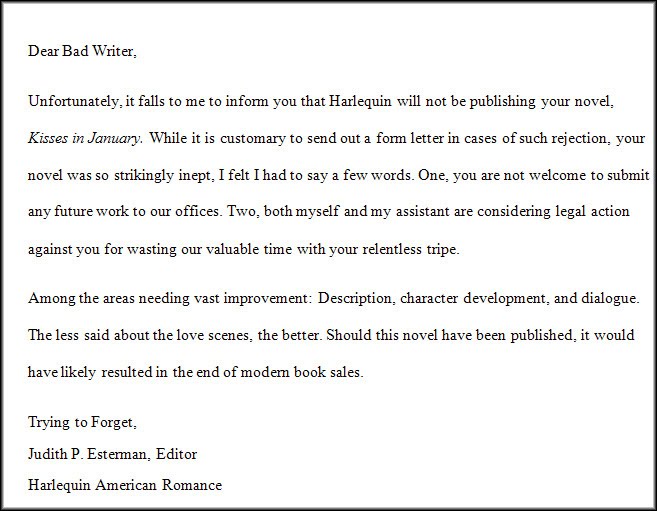
So you see, it does get better, but first you have to pay the rejection dues. I swear, this must be an accountant out there somewhere keeping track of just how many times you have to fail before you’re allowed to find an editor who likes your work, but they’ll never publicize the numbers cause that would be cheating…
-
#WritingPrompt An Egyptian Statue in a r
#WritingPrompt An Egyptian Statue in a real museum showing signs of life. Go. http://ow.ly/mljcz
-
My First Interview!
Last night, Kristen Pham posted an interview with yours truly. She’s doing a series on authorial inspiration and had some very kind things to say about me, so check it out! She also has a pretty stellar blog, so make sure you check out the other posts as well.
-
He Was Very German
I was very excited to learn that one of my favorite authors, Michael Strelow, was coming out with a new book. I had absolutely loved The Greening of Ben Brown, and hoped that his next novel would be as quirky and engaging as his first. I was not disappointed.

Henry: A novel of Beer and Love in the West, is the story of Henry Weinhard, brewer and entrepreneur in the Wild West of Portland. It’s loosely based around the real brewer’s life, but this novel takes us on a whirlwind tour of his life, as told from Henry’s perspective as though he’s rambling on about his life to his grandchildren towards the end of his life. Maybe not his grandchildren, there’s too many lady’s of misfortune for that. But his drinking buddies for sure.
I worried when I first picked up the book that I was going to inundated by the minutia of beer making and the business that entails, but it was just a delightful background to a thoroughly fascinating story. This man apprentices to a brewer in Germany, then makes his way to America and then works his way out to the farthest reaches where they still needed a decent German brewer to make something other than piss-water for the soldiers and lumberjacks. It was then only a natural extension to his business to acquire several pubs, and once he had those to stock the upstairs with slightly more delicate wares. It is a beautiful story of his life, including his love for a woman of poor repute while still carrying on his professional life and marriage.
There is a lot of talk about myths and tales, both those from his homeland and his new land, focusing specifically on the tales of Joshua, man of mystery in the west. There is a lot of philosophizing on staying true to his German heritage while at the same time using it to his advantage. The language of his love is beautiful and stark, showing just how much he truly cared for the woman. He is a complex man, and his is a compelling story.
As for the writing style, I urge people to have just a bit of patience with it. I was used to the round about storytelling style from Strelow’s first novel where its a deliberate choice to fracture the character’s world at the very beginning after his accident. Here, its a much softer swirling of consciousness that ultimately coalesces into a heart breaking series of events. It may seem that his philosophizing or stories about Joshua are tangents, when in fact they are simply the interior support beams for a rather satisfying and emotional climax.
So, if you enjoy excellent writing in a historical fiction setting, this is definitely a novel worth checking out.
-
#WritingPrompt A law of physics is sudde
#WritingPrompt A law of physics is suddenly warped and you have to learn to deal with it. Go!
-
Pros and Cons of Different Types of Publishing
So, as I’ve been contemplating the whole “how do I get myself published” question, I have had to come up against the hard realities of the world and how it views the different tracks publishing can take. I am going to take a little bit of time here and spell out how I see the breakdown of possible publishing avenues, starting with the least respectable to the most respectable. I’m hoping this can answer any questions about why I choose to go the route that I choose.
Self-Publishing
This is the term you don’t want to hear from the mouths of your friends. “Hey, Rebecca, my uncle self-published his memoir and you like books, you should totally buy a copy to help him out!” What this translates to is an unedited mass of papers, spiral or tape bound at Kinkos, with a cover they hand-drew, unedited, full of the kinds of sentences that will make you cry and curse the world. They probably never read it through twice, or even if they did, they decided it was perfect (its not) and think the whole world should think its perfect and don’t understand why the world refuses to acknowledge their greatness with a listing on the NY Times Bestseller list.
Rights you retain: All
Royalty: Anything above printing cost
Distribution: Wherever you can convince to carry it
Cost: Entirely out of pocket, spread out over time
Production value: Low
Vanity Press Publishing
This is slightly better than pure self-publishing. I highly doubt that its been edited, but at least it looks slightly better. It at least looks like a real book. In fact, they may have had a house designer and proof reader go over it (for a fee, usually three times higher than a freelancer could have given you). However, to get it out in the world, you had to pay for every copy up front from a company that really doesn’t care if you succeed or not. So now you have the 5,000 copies you were forced to pay for and no real idea what to do with them. Or you’ve read all the blogs online about how to market them, but you spent all your money getting them printed, so now you can’t afford even a minor marketing scheme.
Rights you retain: All
Royalty: Anything above printing and setup cost. The setup cost can be several thousand dollars
Distribution: Wherever you can convince to carry it
Cost: Entirely out of pocket, large chunk upfront and then printing costs
Production value: moderate
Crowd-Funded Publishing
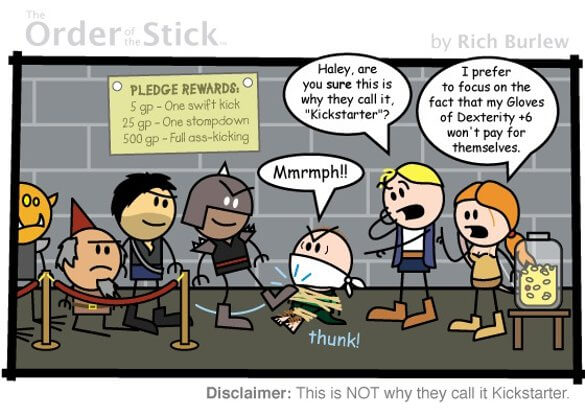
Here’s where things start to get interesting. This is a recent development, what with Kickstarter and Indiegogo. Here, you can reach a wide audience and they can verify that your work has merit, and help fund its launch. Now, you are no longer responsible for bearing the entire burden of the price of editors, designers, and marketing and you can approach the level of production a publishing house could offer. If you’re diligent and internet savvy, you could have the production budget of one of the biggest houses and produce books of verifiable quality. And, with the advent of CreateSpace and Lulu, you need not print anything to have on hand if you don’t want to and can handle all the sales through Amazon, which will also distribute to regular bookstores.
Rights you retain: All
Royalty: Anything above printing cost
Cost: Only what it takes to set up your campaign, be it videographers or what have you.
Distribution: Amazon and the like as well as book store distribution channels
Production value: moderate to high, depending on who you have design it and where you have it printed.
Independent House Publishing
This is getting into the commonly considered ‘respectable’ range. Here, an editor has vetted your work and you’re considered publishable (ie saleable) material. The good part about this is all the copyediting/design/layout and a good deal of the marketing is handled by the house. Which frees you up to be writing your next book. Unfortunately, they’re a small house and can’t afford much in the way of marketing, and probably have a small circulation, unless they’re something like McSweeney’s
Rights you retain: A good majority
Royalty: About 15% of the cover price
Cost: none
Distribution: All Internet and traditional store distribution
Production value: moderate to high, depending on how big the press is.
Traditional House Publishing
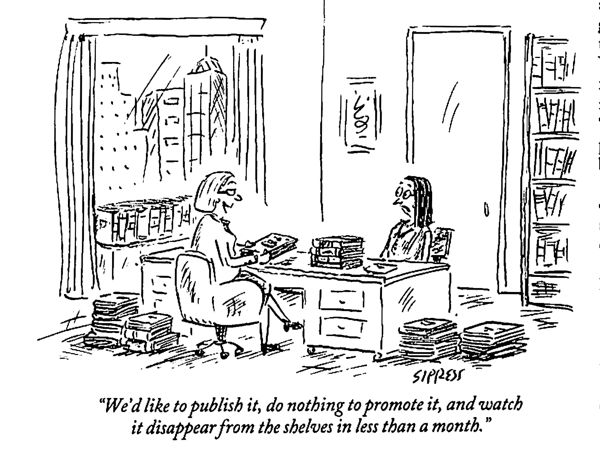
Here is where all the reputation is. Get with Knopf or Penguin or Random House and you’re considered golden. But are you? Sure, they’ll woo you and promise the moon, but they’ll insist on new untested writers giving up way more of their rights than they probably want to and, again as a newb, unless they think you’re the one in a million rising stars, then they’re going to give you virtually no marketing money. They count on your using your advance to do it all on your own. Remember, they’re putting out hundreds of books a year, your’s is only one of them.
Rights you retain: Less than you’re comfortable with
Royalty: as a newb, maybe 10%
Cost: none
Distribution: All Internet and traditional store distribution
Production value: Usually pretty excellent
Given all of this, I personally would feel much more comfortable an Indie press or going with the crowd-funded option. Either way, I know I’m going to be producing quality. And with the crowd-funded option, I actually get to keep all the rights myself and get a much more vast royalty than I would with a house. BUT what I am giving up is the experience, connections, and reputation of a house publication. And that’s a hard pill to swallow. Now, I have not yet given up on the possibility of a house deciding I’m worth their time, but I have also come to the decision that crowd-funding the book is just about as good. I can raise the money to do a proper edit and copyedit of the work, and, if I hadn’t been so design-orientated myself, I could hire a decent designer. And then, I can pay for a decent marketing campaign to try and get it into as many readers hands as possible.
And now you know where I stand on all this. Now, if Random House turned around tomorrow and promised me the moon, I’d have a damn hard time turning them down, because, let’s face it, who wouldn’t want that sort of reputation boost? But I would have to sit down and seriously consider all of my options before accepting a steep drop in royalties and the loss of control over a lot of my rights.
Jane Friedman also recently explored this topic in a slightly different manner, and I’ve included her infographic below.

-
Writing Prompt! These cats hold a specia
Writing Prompt! These cats hold a special place aboard these vessels. Tell me about it. http://ow.ly/lrkxp
-
For a Good Cause
Some people publish their writing because they want to be famous, some because they want to be rich, some because they’re driven to share a story, and still others publish because its the right thing to do.

Dylan Siegel is one of the last in that list. At six years old, he’s raised over $200,000 to help out his best friend, a young boy suffering from a nasty liver condition, by funding research to help find a cure. The way he did this? He wrote a book called Chocolate Bar and sold it to raise money. His goal is to raise one million dollars and he’s well on his way.
So, why not support an excellent cause, and a budding writer, and pop on over to their website and help them out?

-
Writing Prompt! Explain this: http://ow.
Writing Prompt! Explain this: http://ow.ly/l6imF
-
As I embark on the last edit of Undelive
As I embark on the last edit of Undeliverable, check out this awesome word cloud of the novel! http://ow.ly/i/2hjO1




-
Subscribe
Subscribed
Already have a WordPress.com account? Log in now.
 Rebecca A. Demarest