-
I Need to Write Better than I Normally Do
Do a friend of mine recently posted this article to her facebook and I just had to share it with you here. I adore McSweeney’s; they are absolutely hilarious and always intelligent. That’s a rare combination these days. This particular article by Colin Nissan is about Writing Better than you Normally Do, which I so needed to read right now as I embark on a new edit of my novel, since apparently agents are currently finding my main character hard to sympathize with at the beginning of the novel.
Anyway, enough about me, see how you can get this to make you write better…
THE ULTIMATE GUIDE TO WRITING BETTER THAN YOU NORMALLY DO.
BY COLIN NISSAN
– – – –WRITE EVERY DAY
Writing is a muscle. Smaller than a hamstring and slightly bigger than a bicep, and it needs to be exercised to get stronger. Think of your words as reps, your paragraphs as sets, your pages as daily workouts. Think of your laptop as a machine like the one at the gym where you open and close your inner thighs in front of everyone, exposing both your insecurities and your genitals. Because that is what writing is all about.
DON’T PROCRASTINATE
Procrastination is an alluring siren taunting you to Google the country where Balki from Perfect Strangers was from, and to arrange sticky notes on your dog in the shape of hilarious dog shorts. A wicked temptress beckoning you to watch your children, and take showers. Well, it’s time to look procrastination in the eye and tell that seafaring wench, “Sorry not today, today I write.”
FIGHT THROUGH WRITER’S BLOCK
The blank white page. El Diablo Blanco. El Pollo Loco. Whatever you choose to call it, staring into the abyss in search of an idea can be terrifying. But ask yourself this; was Picasso intimidated by the blank canvas? Was Mozart intimidated by the blank sheet music? Was Edison intimidated by the blank lightbulb? If you’re still blocked up, ask yourself more questions, like; Why did I quit my job at TJ Maxx to write full-time? Can/should I eat this entire box of Apple Jacks? Is The Price is Right on at 10 or 11?
LEARN FROM THE MASTERS
Mark Twain once said, “Show, don’t tell.” This is an incredibly important lesson for writers to remember; never get such a giant head that you feel entitled to throw around obscure phrases like “Show, don’t tell.” Thanks for nothing, Mr. Cryptic.
FIND YOUR MUSE
Finding a really good muse these days isn’t easy, so plan on going through quite a few before landing on a winner. Beware of muses who promise unrealistic timelines for your projects or who wear wizard clothes. When honing in on a promising new muse, also be on the lookout for other writers attempting to swoop in and muse-block you. Just be patient in your search, because the right muse/human relationship can last a lifetime.
HONE YOUR CRAFT
There are two things more difficult than writing. The first is editing, the second is expert level Sudoku where there’s literally two goddamned squares filled in. While editing is a grueling process, if you really work hard at it, in the end you may find that your piece has fewer words than it did before. Which, is great. Perhaps George Bernard Shaw said it best when upon sending a letter to a close friend, he wrote, “I’m sorry this letter is so long, I didn’t have time to make it shorter.” No quote better illustrates the point that writers are very busy.
ASK FOR FEEDBACK
It’s so easy to hide in your little bubble, typing your little words with your little fingers on your little laptop from the comfort of your tiny chair in your miniature little house. I’m taking this tone to illustrate the importance of developing a thick skin. Remember, the only kind of criticism that doesn’t make you a better writer is dishonest criticism. That, and someone telling you that you have weird shoulders.
READ, READ, READ
It’s no secret that great writers are great readers, and that if you can’t read, your writing will often suffer. Similarly, if you can read but have to move your lips to get through the longer words, you’ll still be a pretty bad writer. Also, if you pronounce “espresso” like “expresso.”
STUDY THE RULES, THEN BREAK THEM
Part of finding your own voice as a writer is finding your own grammar. Don’t spend your career lost in a sea of copycats when you can establish your own set of rules. If everyone’s putting periods at the end of their sentences, put yours in the middle of words. Will it be incredibly difficult to read? Yes it will. Will it set you on the path to becoming a literary pioneer? Tough to say, but you’re kind of out of options at this point.
KEEP IT TOGETHER
A writer’s brain is full of little gifts, like a piñata at a birthday party. It’s also full of demons, like a piñata at a birthday party in a mental hospital. The truth is, it’s demons that keep a tortured writer’s spirit alive, not Tootsie Rolls. Sure they’ll give you a tiny burst of energy, but they won’t do squat for your writing. So treat your demons with the respect they deserve, and with enough prescriptions to keep you wearing pants.
-
Silo Trees Flash
“Oh, pull over, pull over, this one is perfect!” Trish reached into the back seat of their volvo and dragged her camera bag onto her lap. Cody sighed and turned on his hazard lights, drifting to a stop on the old country highway.
“Haven’t you run out of film yet? This is the fifteenth farm you’ve said is perfect in the last two days.” He slumped in his seat, arms crossed as the traffic whisking by made the car rock.
“Nope! I’ve been rationing myself.”
“I’m almost afraid to ask.”
“I’ve made it through 30 rolls of film so far and have another 15 still in the trunk. I’ll be right back!” She leaped out of the car and hurried to the broken fence surrounding a farm house that was boarded up and falling in.
“You should try going digital!” Cody shouted from the open window, but Trish ignored him. “I had to date an artist. Photography’s not art, it’s record keeping.” He pulled out the latest graphic novel from Darkhorse and prepared for a long wait. She could take upwards of an hour trying to get just the right angle and light on these stupid buildings. One of these days she was going to get herself shot for trespassing and all he was going to do was laugh.
“Cody!”
For a second he thought she had been caught and felt briefly bad about laughing at the mental image of Trish with buckshot in her ass. But when he looked up at her bustling through the field, she was laughing.
“You’ve got to see this, come on!”
He sighed, turned the car off and waited for a break in traffic before getting out. Maybe if he humored her they would actually get to their friend’s cabin before dark.
When he reached the fence, she had already disappeared behind the house again, so he made his way through the waist high grass, praying there were no ticks. When he made it around, inspecting his legs all the while for ticks, he sighed. “What is it?”
“Look.” She was just in front of him, pointing towards a small silo that had been obscured from the road. It took him a moment for his brain to make sense of the scene, but he finally figured that the tree he saw had to be growing out the top of the silo and not behind it.
“Is that tree actually in the silo?”
“Yes, I’ve heard of this but never seen it before. A seed blows in, grows straight up for years with hardly any sun and then, bam, it hits the clear sky and just explodes. They call them Silo Trees. How imaginative. Let’s see if we can climb in!” She ran off towards the silo, camera jouncing against her breast.
Cody followed more slowly, still finding it hard to get his mind to accept the layering of the landscape as he knew it had to be. The lower hatch on the silo had rotted away ages ago and she crawled in, Cody right behind her. They were barely in before she was angling around with her camera, hunting for just the right lighting.
The snapping of the shutter annoyed him and he reached around her and took the camera out of her hands just as the shutter snapped at an odd angle. “Hey! You ruined the shot!”
“Shhh.” He pulled her close to him, so they were both facing the tree. “Just take a moment and see this, don’t just look at it. How long do you think it took this tree to do this?”
She squirmed a little, but gave in when he refused to loosen his hold. “I dunno, a long time.” She made a grab for her camera which he held out of her reach for a moment more, hoping she’d quiet down. She didn’t
He finally gave her back her camera and she started rolling around on the ground looking for just the right angle. He shook his head and walked over to the trunk of the tree. “I wish I had the kind of patience this tree had.” It had the straightest trunk he’d ever seen. He made for the hatch, calling back, “Make sure you brush off before getting back in my car.”
She ignored him.

-
Writing Prompt #23
Play along by posting your response in the comments!
For this week, let’s contemplate when nature retakes its ground. Contemplate these gorgeous photos for a moment:
Trees are apparently taking over old silos, called Silo Trees, go figure.
Love this one too…
Now, paint us a word picture around nature taking apart man’s structures.
-
These Are Your Kids on Books
This image has been burning through the internets the last few days, and I think it’s just awesome:

What most people miss is that this image is advocating Burning Through Pages, an awesome non-profit to encourage children to read. Check them out and give them encouraging words, or, if you feel moved to, donate to help them spread books to kids! We will teach them to dream, and achieve, the impossible dreams.
-
Wait…Is There Magic?
I had been hearing good things about Ann Patchett and so when I walked by the book share at work and saw The Magician’s Assistant, I decided to give it a try. I didn’t know much about either the author nor the novel except that I was supposed to read her, so I was quite surprised when I started reading.
First off, the book starts with the magician’s death–and not in any spectacular fashion, but a brain aneurysm. And then Sabine, his assistant for over 20 years and his wife for less than 2, is left to deal with the loss of the man she always loved, but who was gay. So there wasn’t much magic, except for some dreams that I’m not sure were supposed to be simply her subconscious trying to help her cope, or an actual spiritual experience and she was connecting with her dead husband’s dead lover. On top of dealing with this loss, she also comes to find out that her husband had lied about his family: they were not dead, but living in Nebraska. And they want to get to know her and, through her, the life their son led.
But beyond this rather odd set-up, the writing was beautiful. I didn’t want to put the book down because it did such a wonderful job spinning the fragile world that Sabine found herself in. And there was just enough hint of magic to keep it from becoming too heavy. In fact, I feel the whole novel can be summed up in how she describes Sabine during a particular magic trick…levitation. She had to hold herself completely rigid and was under incredible stress in order to make it look like she was effortlessly floating on air.
The whole experience was a rather pleasant surprise and I’d definitely suggest reading at least this novel. And now I need to go track down Bel Canto as I’ve been told that’s her best–though after this novel, I can’t imagine how things can get better.

-
Public Transportation Flash
I decided his name was Marlin. It just felt right. An old style name for a man who obviously wasn’t all that comfortable in this decade, for all that he was in his early twenties. His black suit was slightly too small and over-drycleaned, the white shirt slightly transparent. His too-short pants legs revealed thick black socks but worn brown shoes that featured two different colors of polish. He carried a faded, gray felt hat and a hardcover book missing its jacket, his hand obscuring the title on the spine. The only part of his attire that looked at all wealthy was a bright blue silk tie and pocket square set. I decided they had been a gift to him.
He sat there, chewing absently on the inside of his lip, occasionally smiling to himself or holding in a yawn, oblivious to the rest of the midday traffic. He had entered the train at MGH and, though I desperately wanted to talk to him, find out what book he was carrying, I found myself held back by his seemingly contented self-absorption.
Instead I started to build a life for him. He was a medical student, since he had gotten on by the hospital, during his last bit of residency. He came from a rural town up in Maine and that was his father’s suit, the tie the only new thing his mother had been able to afford to give him as he was heading off to the city to become a doctor. Because that was all he had ever wanted to be. He had been a healer all his life: stray birds, childhood scrapes and bumps. He never flinched at blood or a broken bone. The town had banded together and raised as much money as they could to send him off to the big city, because they knew it was expensive. Marlin didn’t have the heart to tell them that they only managed to raise enough money for half of one semester. He thanked them profusely, joking that now he didn’t need to find a job while studying.
He planned to return to his home town when he had finished, open a practice with emergency services out in the rural area so things like his father’s accident weren’t such a tragedy. So he focused on trauma medicine, spending as much free time in the ER as humanly possible. In fact, he was just getting off shift now. It had been a good night, no deaths, and slow enough that he could flirt with the desk nurse. He had started to hope that she might follow him home. Maybe at first just as a new nurse for his practice, maybe as more later, when they knew each other better.
The train was entering Harvard now and Marlin stood, shedding the story I had created for him. I wanted to follow him out of the train, catch up to him and talk to him, ask him about his childhood sister and their farm, playing freeze tag in the cow pasture where they pretended that cow patties were freezing landmines. But he was gone and the doors were closed by the time I had worked up the courage to follow.
__________________________________________________________________Also, this guy:
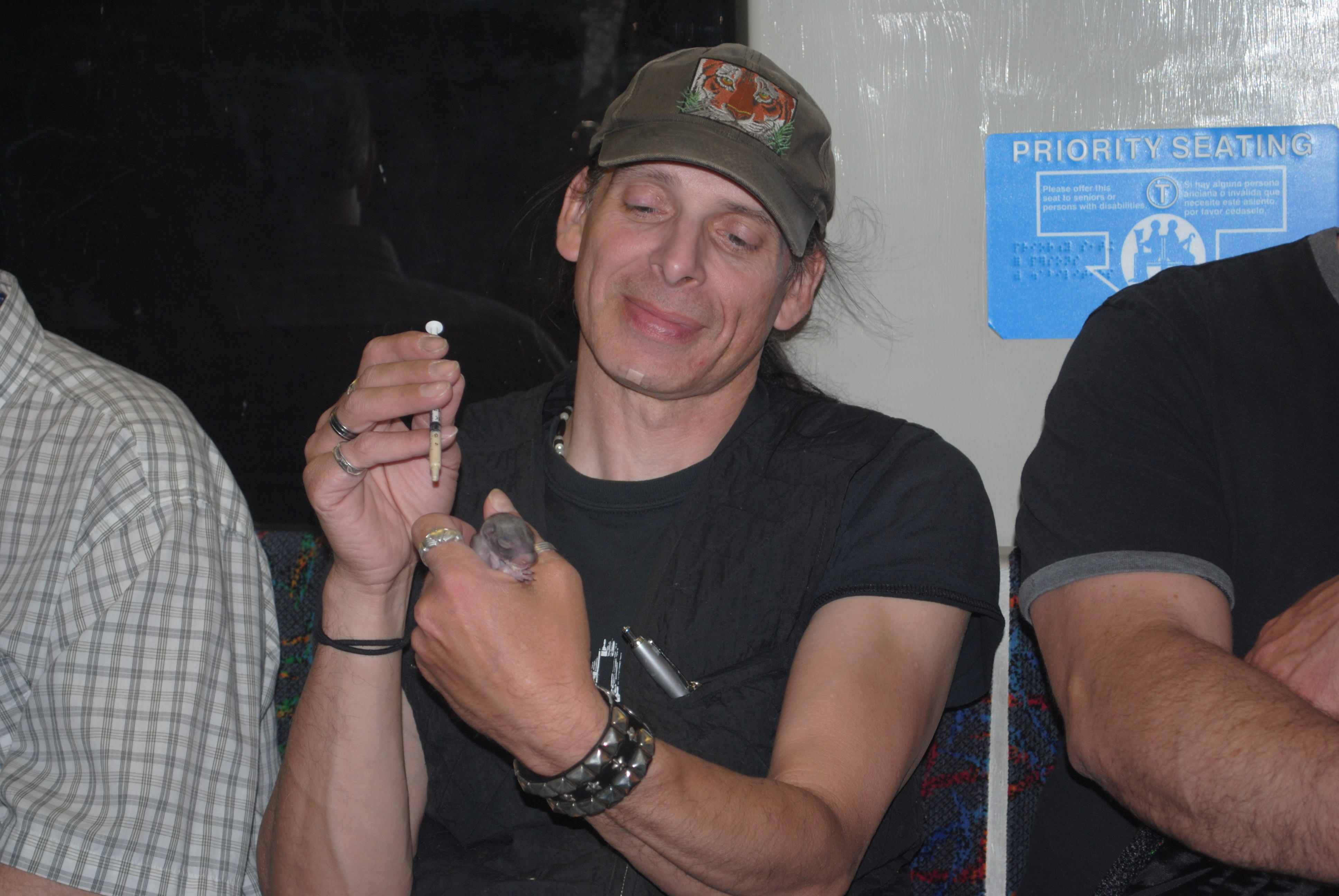
Yes, he’s feeding a baby squirrel, on the Red Line in Boston.
-
Writing Prompt #22
Play along with the writing prompt in the comments below!
This week we’re going to talk about public transportation. Unbury yourself from your Kindles and Nooks and iPads and iPods and MP3 players and take a moment to immerse yourself in the humanity around you. There are some very interesting people on the subway car next to you, hanging over you on the hand rails. Pick one. Write their story…
-
More Murakami
Alright, since I loved 1Q84 so much, I thought I’d tackle one of Murakami’s smaller novels, Kafka on the Shore. In this novel, we are again following a dual storyline (not sure if this is a pattern in his novels yet or not, since I’ve only read two and two data points does not a correlation make) but this time it is a young boy who has run away from home and an unusual older gentleman who talks to cats and seems to be a conduit for the young man’s actions. They never come together in the book, except in that their actions work together in an odd sort of way.
As you can probably tell by now, I have to admit I was a bit confused by this one. I really enjoyed it, the writing was again fantastic and the story was engrossing but…I’m not really sure what…the point was? I feel like I’ve just read 400 pages of dense Tao proverbs that should be inspiring and transcendental but they just went completely over my head. I got to the end of the novel, turned the last page, and went…”And…k? Hmm…”
And, as with 1Q84, there are some rather distinct fantastical elements to this one, perhaps with a slightly more science fiction bent due to the sighting of an unknown craft just before events that make our old man as odd as he is. And, again, Murakami feels he needs to point out to the readers that he is not engaging in something as trite as genre fiction when a secondary character, Oshima, says, “What you’re talking about, Kafka, is just a theory. A bold, surrealistic theory, to be sure, but one that belongs in a science fiction novel.” Which is basically what this is. But I’m not going to get into another genre discussion today.
Overall–even though I have no idea what happened at the end of the novel or what I’m supposed to be taking away from it–I truly enjoyed this novel and found myself satisfied with my slightly puzzled response. At least you can say I’m still thinking about it and trying to puzzle through the rather mystical events and connections that permeate it and just what, exactly, they were trying to tell me. I think it might be important…

-
The Wondrous Smell of Books
-
Coming of Age Flash
I took this prompt to explore an aspect of the new novel I’m working on, so if it doesn’t all make sense yet, in context of the novel it will. For now, please put up with the unusual terminology.
__________________________________________________________________“Sadly, most characters don’t make it out of their inspirationcy.” The tour guide ushered a group of newly pressed characters through the incubation hall where characters were kept before their creators shared them with anyone else. Their chambers lined the walls, the characters in various stages of formation from their ember state to nearly full grown characterhood. The characters following the tour guide were only a few days past their pressing themselves, but had been declared readable by the experts at the main Hearth.
Sophia inched passed them on her way to the main hearth, wondering why they chose to show this morbid site to the newly pressed. Half of the characters in the incubation chambers fizzled out at the ember stage, another quarter would fade out before they were even fully formed. The last quarter might make it out of the incubators, but of them, only half were ever considered readable, and many of those had to be confined to various institutions for the criminal or insane. It was a sad truth that most of human literature required evil of some sort to spur the story along, and those characters were written into existence right along with the good.
Even after that winnowing process, only a few characters would make it past their fifth year. At that point, they were either published or shared enough to not be immediately forgotten, or their authors and tellers had given up on them and moved on to new stories. Most people thought that the fading out process was painless, a sort of drifting away from yourself not unlike Alzheimer’s, with the added effect of your body fading along with your mind.
Shhft-pop
An ember Sophia passed shriveled out of existence. Another was slotted into place as she shuddered and hurried on, listening with half an ear to the tour guide. “How many of you have heard of the Cannonizing?” A few hands went up. “Excellent. It’s what we all strive for. If, after 10 years, you have thrived as a character with no major assistance from the Storytellers here, you may be Cannonized. Can anyone tell me what that entails?”
Sophia could, but no one who hadn’t already been through it could possibly come close to knowing. It was a secret kept not through silence, but through active dissemination of ludicrous lies. Mainly because most people were too awed by their experience during the Cannonization to want to talk about it. It was intensely personal.
Essentially, a character was brought to the central hub where there was a feast for all the characters being Cannonized. It used to be for each individual candidate, but was now a huge party due to the sheer volume of characters being created every day. Afterwards, the characters would go singly into the main hearth chamber and kneel before the hearth to hear the voice of the Storyteller, the real one, not the acolytes wandering around. The Storyteller would then whisper a story into your ear. A story you alone got to hear and were required to keep in your heart. It contained all the possibilities for you as a character, all the ways your life could go, and how you yourself could shape it now that you were an established character. It was a pledge from the Storyteller to do Their damndest to keep you in active memory and and demand from you to keep as many characters alive in your heart as possible.
It would feel like hours, when in reality only a few minutes had passed. Sophia was almost certain that they were drugged at the parties in the last 200 years or so since she knew the Storyteller hadn’t spoken to anyone at a Cannonization since her own. She knew because They had told her they would remain silent until she had finished the task set to her.
-
Subscribe
Subscribed
Already have a WordPress.com account? Log in now.
 Rebecca A. Demarest